Free Things To Do In Lanzarote Wine Country: The Zero-Euro Day
Lanzarote's wine country is one of the few European vineyard regions where the landscape itself is the main attraction and the landscape charges nothing. Here is what you can genuinely do for free in and around La Geria, what still costs money, and where the zero-euro day runs out.
Short answer
The genuinely free things are the roadside miradors over the vine pits along the LZ-30, walking among the zocos at Uga and Masdache, Rubicón's free facility access daily 10:00 to 19:00, the Casa Museo del Campesino, and the Timanfaya viewpoints outside the paid park road. Every bodega charges for the pour itself, from EUR 3.50 a glass upward.
What Can You Actually Do For Free In Lanzarote Wine Country?
The honest answer is: a surprising amount, but none of it is wine. The vine pits, the zocos, the miradors along the LZ-30, the village of Uga, the Masdache bodega strip, the Casa Museo del Campesino and the viewpoints outside Timanfaya's paid road all cost nothing. The pours are the paid part, and every bodega on the island charges for them, from EUR 3.50 a glass at Los Bermejos upward.
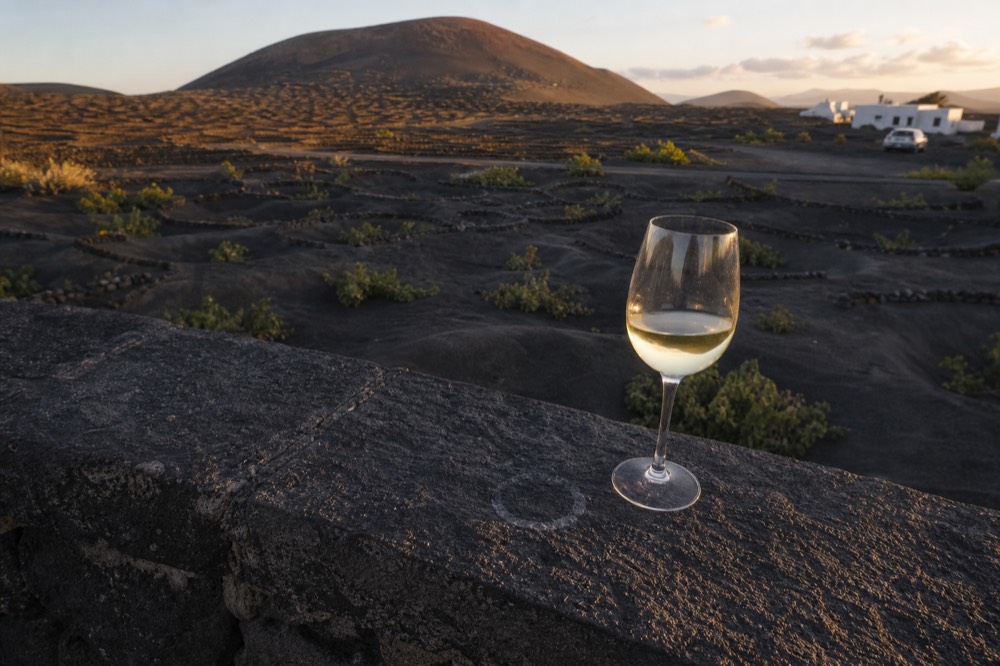
That split, landscape free and liquid paid, is the whole shape of a zero-euro day in La Geria. The reason is structural. La Geria is a Protected Landscape of 5,255 hectares across five municipalities, not a gated attraction. The vineyards sit on either side of a public road, the LZ-30, which runs the length of the valley from the Monumento al Campesino junction down to Uga. Everything visible from that road is free to look at, and the viewing is spectacular: thousands of scooped hollows in black ash, each one holding a vine, each one ringed by a half-moon of dry stone.
The island's growing system was added to the FAO's Globally Important Agricultural Heritage Systems list in 2025, registered as "Agricultural Systems in Jable and Volcanic Sands in Lanzarote Island, Spain". That is international recognition of a landscape you can currently stand beside for nothing, on a public verge, with no ticket, no queue and no time slot. It is worth building a day around before you spend a euro.
This guide walks through each free element in turn, what it is, where exactly it sits, and where the free version ends. If you are planning a wider trip around the valley, our La Geria wine region guide covers the landscape's history and protection status in depth, and the driving the La Geria wine route guide handles the road itself, including the event closures that occasionally shut the LZ-30.
The Roadside Miradors Over The Hoyos: The Best Free View On The Island
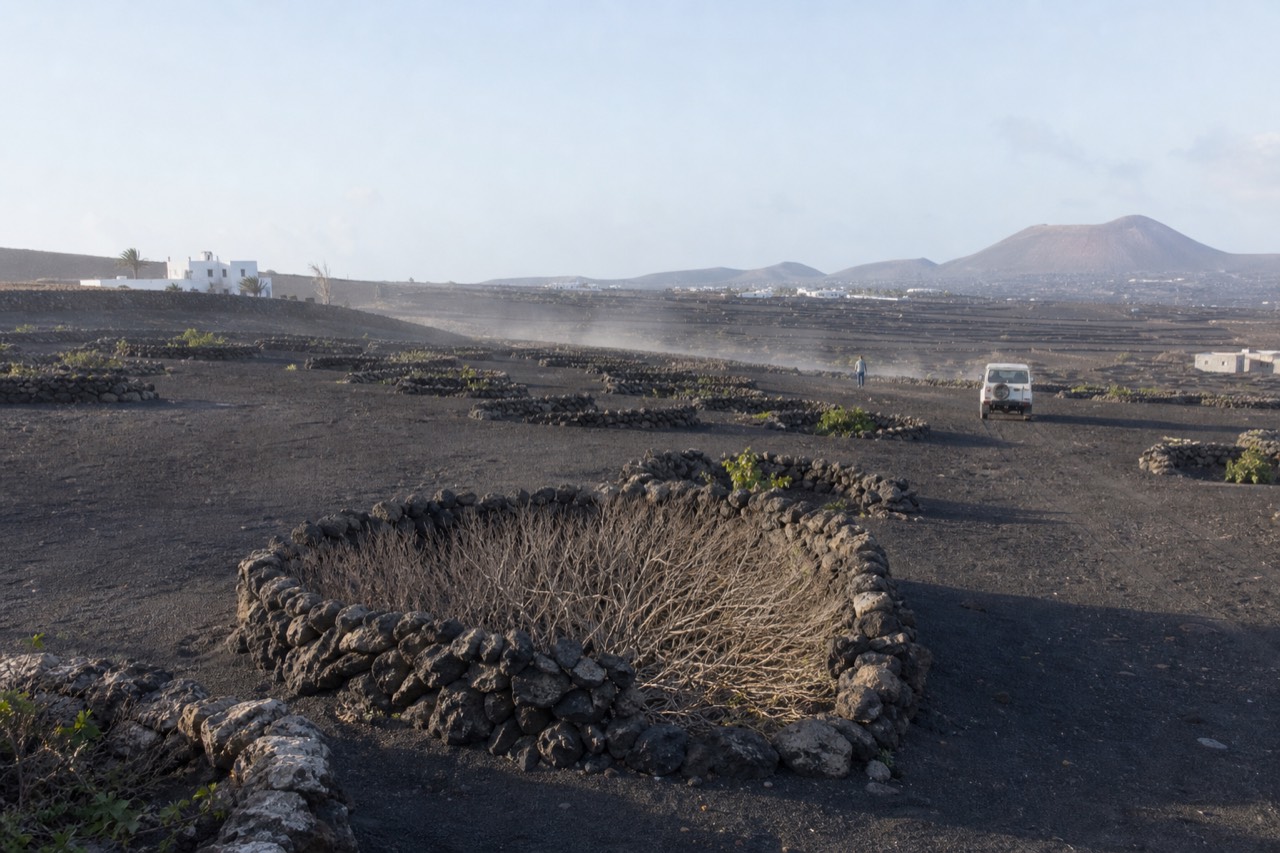
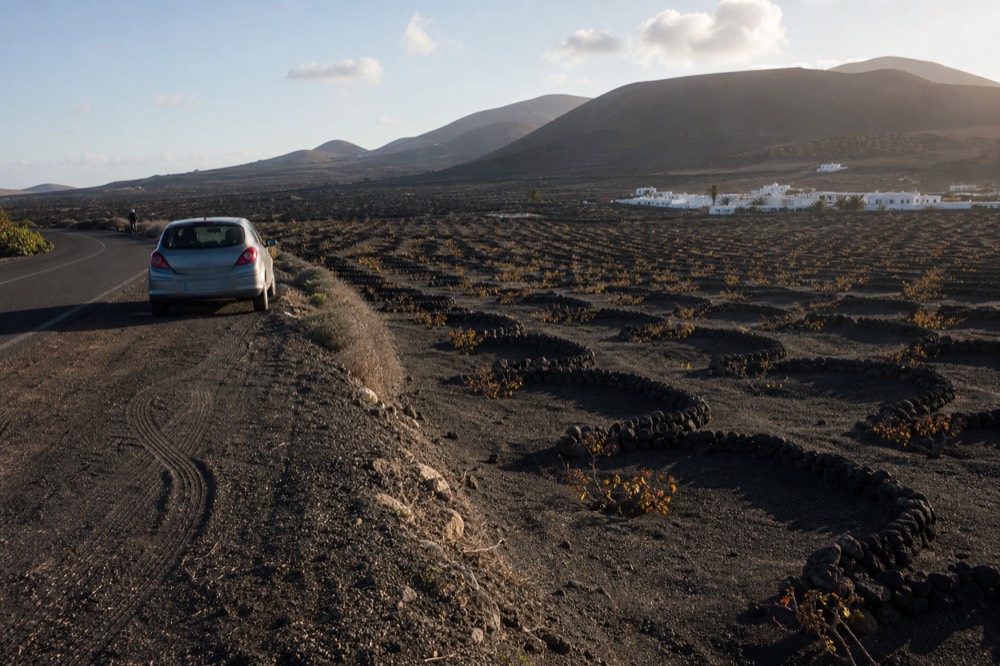
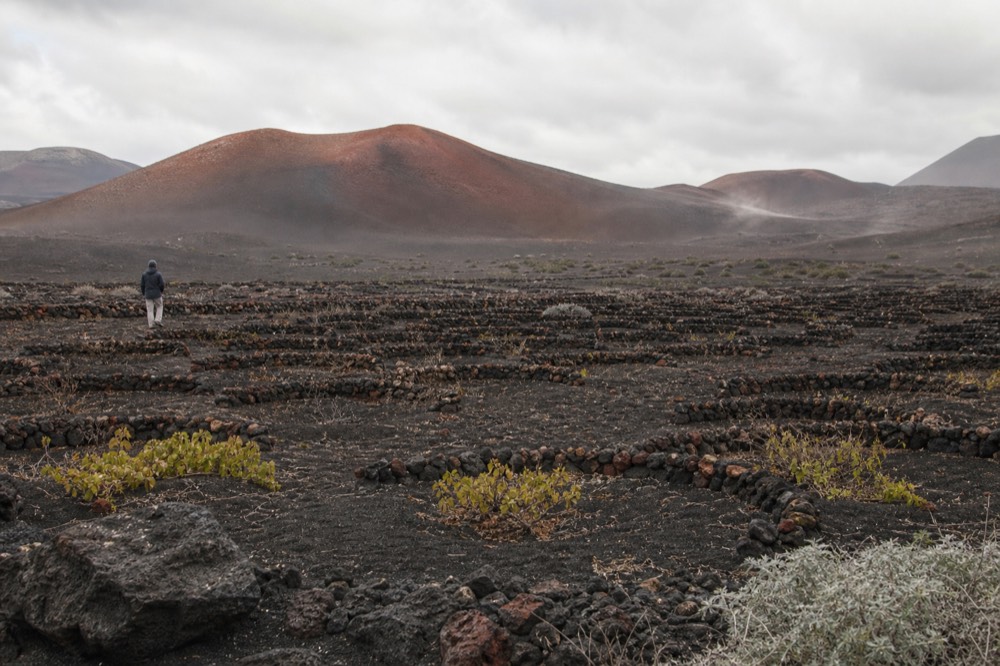
The single best free thing in Lanzarote wine country is simply stopping the car along the LZ-30 and looking at the hoyos. These are the vine pits, roughly three metres across and two to two and a half metres deep, dug down through the volcanic ash to the buried pre-eruption soil. In the deepest-ash zone there are about 36 of them per hectare, against thousands of vines in a conventional vineyard. No fence, no fee, no ticket.
The pits are the whole story of the place. When the eruptions of 1730 to 1736 buried this land, the farmland under lava flows was gone for good, but where ash fell instead, farmers dug down through it and recovered the soil. Each hollow holds one or a few vines, sheltered from the trade winds by a semicircular dry-stone wall, the zoco. The walls all face the same way because the wind does: they shield the vine from the north-northeasterly trades, and once you have noticed that, you can read the wind direction off the landscape from any stopping point on the road.
Practicalities matter here. There is no official published kilometre length for the LZ-30 through La Geria, so do not trust an itinerary that quotes one. What is verifiable is that the road runs the length of the valley and that pull-ins and verges appear along it. Be careful where you stop: this is a working road with tour minibuses on it, and the verges are part of a protected landscape. Use the established pull-ins rather than improvising, and never walk into the pits themselves, the ash is loose, the pits are deep, and the vines are somebody's crop.
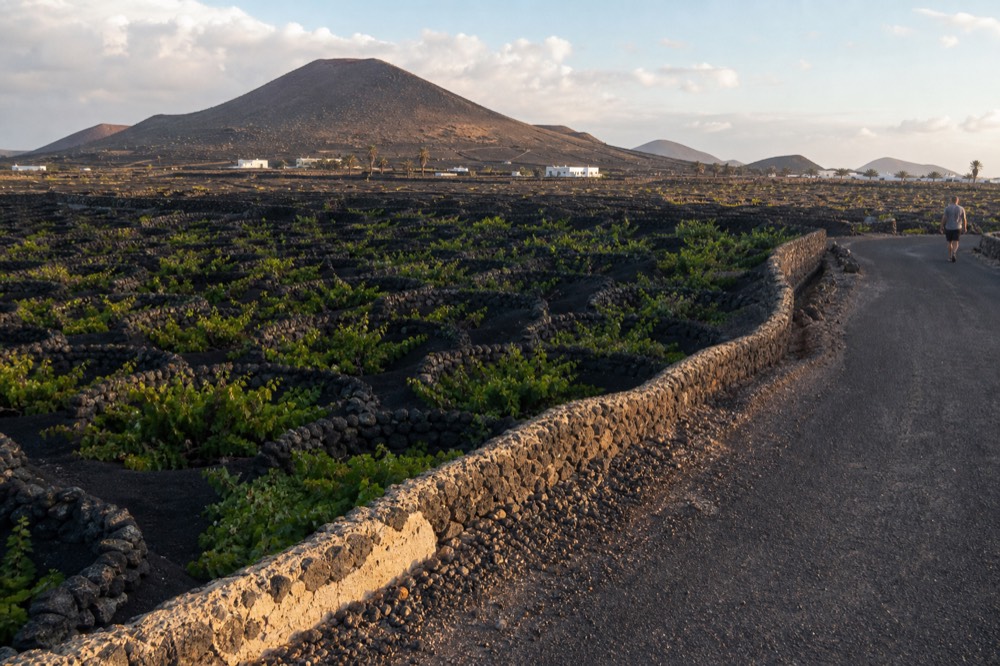
The view costs nothing, but the day does not have to end there. Fancy a guide and a glass with the views? Three picks suit a free-driving day in the valley especially well: the $28 vineyard tasting with chocolate, its sunset twin, and the small-group hike through La Geria that puts you inside the landscape on foot.
All three are built around the same valley you have just been looking at for free, and every tour on our roster offers free cancellation, so booking one does not lock your day into a shape you cannot change.
Walking Through The Zocos At Uga And Masdache
Uga, at the southern end of the LZ-30, and Masdache, the hamlet in the middle of the valley, are the two places where you can walk among the vineyards rather than just view them from a verge. Both cost nothing. Uga sits at the edge of the deepest-ash zone, where the pits are at their biggest and sparsest. Masdache sits where the ash layer thins and the planting gets denser, because artificial enarenados dominate there.
The contrast between the two is the payoff for walking both. Around Uga and the Tablero de Uga area, surveyed densities reach about 250 pits per hectare in the smaller-pit zone, while north of Montaña Chupaderos and Diama the big pits run at about 36 per hectare, each holding two or three vines. Masdache is where farmers carted ash in themselves, so the hoyos there are shallower, often under half a metre of brought-in rofe, and the vineyards read almost like a different farming system. You can see all of this from public lanes and footpaths without entering private land.
Two honest cautions. First, the ash is not a footpath: it is loose gravel on a slope, in a desert climate with under 150 mm of rain a year and effectively none between June and August. Wear real shoes, take water, and treat midday in July and August with respect. Second, the vineyards are working farmland inside a protected landscape, and about 237 hectares of the 1,368 hectares under cultivation inside the protected space are currently abandoned, so not every pit you pass is tended. Stay on lanes, leave the zocos alone, and take your rubbish with you.
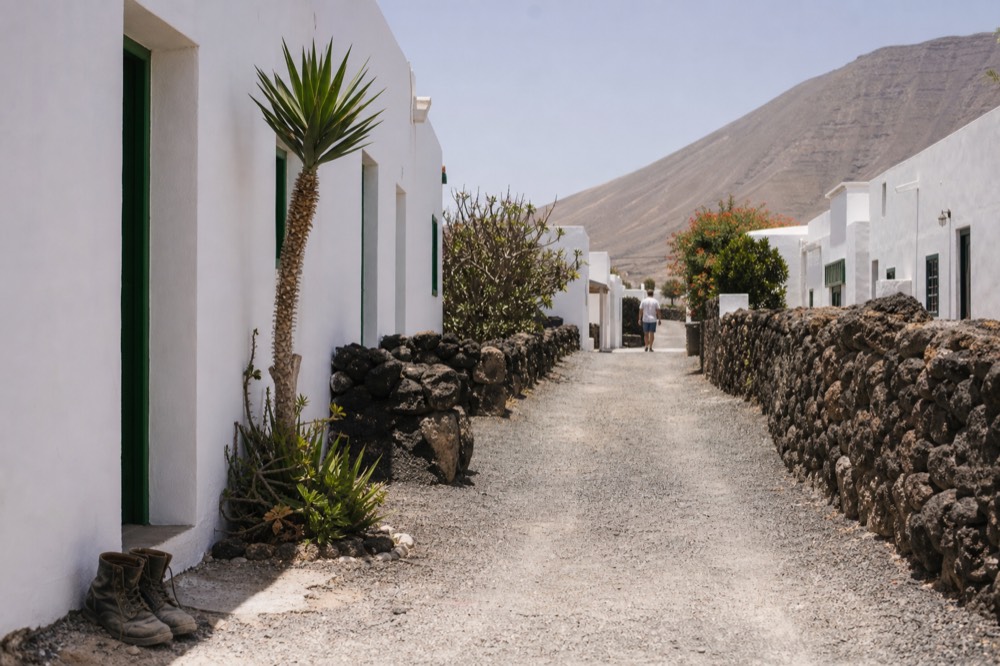
Uga is also, conveniently, the home of Stratvs, whose shop and winery are open daily 10:00 to 19:00, and whose vineyards, 52 hectares in La Geria plus 25 in Uga, spread around the village. Walking the lanes and browsing the shop are separate activities, and the second one is where the free day starts leaking money, in a good way. The restaurant there serves daily from 12:30 to 19:00 if your zero-euro day needs a lunch stop.
If walking the valley on your own sounds like navigation you would rather not do, the guided alternative is the small-group hike with wine and cheese at the end: $55, 4 hours, capped at 10 participants, with pickup included, rated 4.9 across 211 reviews. It covers the same landscape with someone who can explain what you are looking at.
The question worth asking yourself at this point in planning is simple: is today a landscape day or a tasting day? The free itinerary covers the first completely. The second needs a booking, and the cheapest one on the island is the $28 chocolate pairing at a family bodega, which the operator flags as likely to sell out.
Free Winery Access: What "Free Entry" Really Gets You At A Bodega
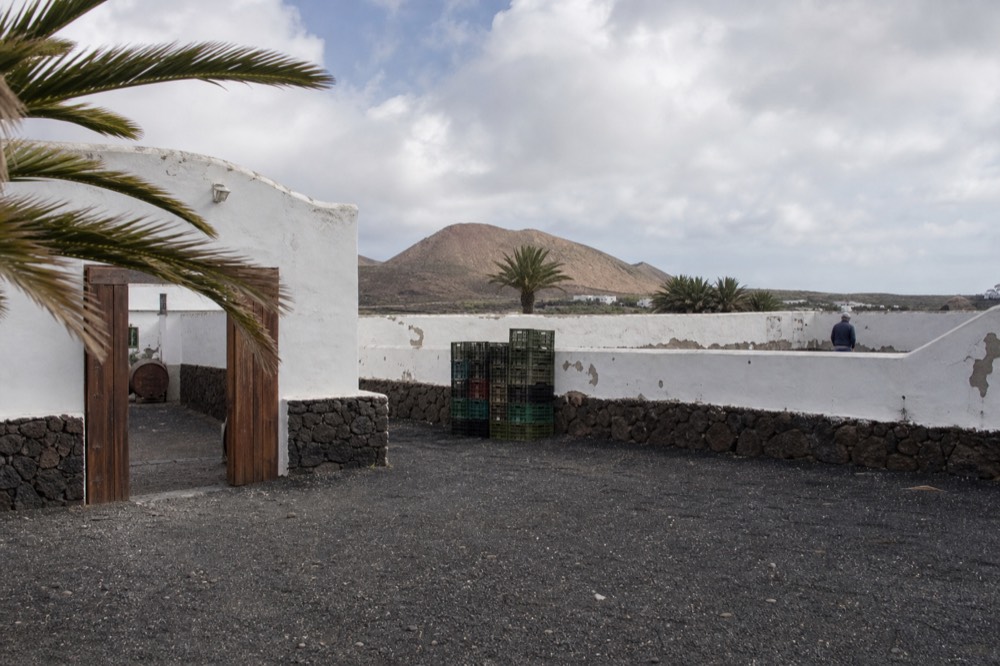
Only one winery in La Geria publishes free access to its facilities: Bodegas Rubicón, at El Cortijo de La Geria, whose grounds are open free daily from 10:00 to 19:00. You can walk the estate, see the 16th-century cortijo buildings and stand on the terrace over the Timanfaya volcanoes without paying. The guided tastings cost extra: EUR 22 for the standard tour, EUR 40 for the premium one.
This is the nuance most visitors miss. "Free entry" at a bodega means the grounds and the shop, not the pour. Rubicón is genuinely generous with it, the estate's century-old vines sit right there inside the protected landscape, and the terrace view over Timanfaya National Park and the village of Uga is one of the best in the valley. But the two guided experiences, "Entre Muros y Viñedos Centenarios" at EUR 22 (ages 11 to 17 pay EUR 5) and "El Legado Rubicón" at EUR 40 (ages 11 to 17 pay EUR 9), are paid products, and the standard one runs daily at 13:30 with a minimum of 6 and a maximum of 12 people.
Elsewhere the pattern is consistent: nobody pours for free. Los Bermejos in San Bartolomé sells tastings by the glass at EUR 3.50 each with a cheese cap, no booking needed, Monday to Friday 08:00 to 15:00, and its guided visit is EUR 21 per person. El Grifo's entry-level audio tour plus two-wine tasting is EUR 15, with children up to 17 free. Bodega La Geria and Stratvs do not publish per-person prices at all, their prices sit behind booking widgets. That is the honest baseline: in Lanzarote wine country, the landscape is free and the wine never is.
| Winery | Free part | Cheapest paid tasting | Hours to know |
|---|---|---|---|
| Bodegas Rubicón | Full facility access, grounds and terrace | EUR 22 guided tour with 2 wines and cheeses | Free access daily 10:00-19:00 |
| Los Bermejos | Nothing published as free | EUR 3.50 per glass with cheese cap | Mon-Fri 08:00-15:00 |
| El Grifo | Free for children up to 17 on the audio tour | EUR 15 audio tour plus 2-wine tasting | Mon-Fri, last entry 17:15 |
| Bodega La Geria | Grounds and views only | Price on the booking widget | Daily 10:00-19:00 |
| Stratvs | Shop and winery browsing | Price not published | Daily 10:00-19:00 |
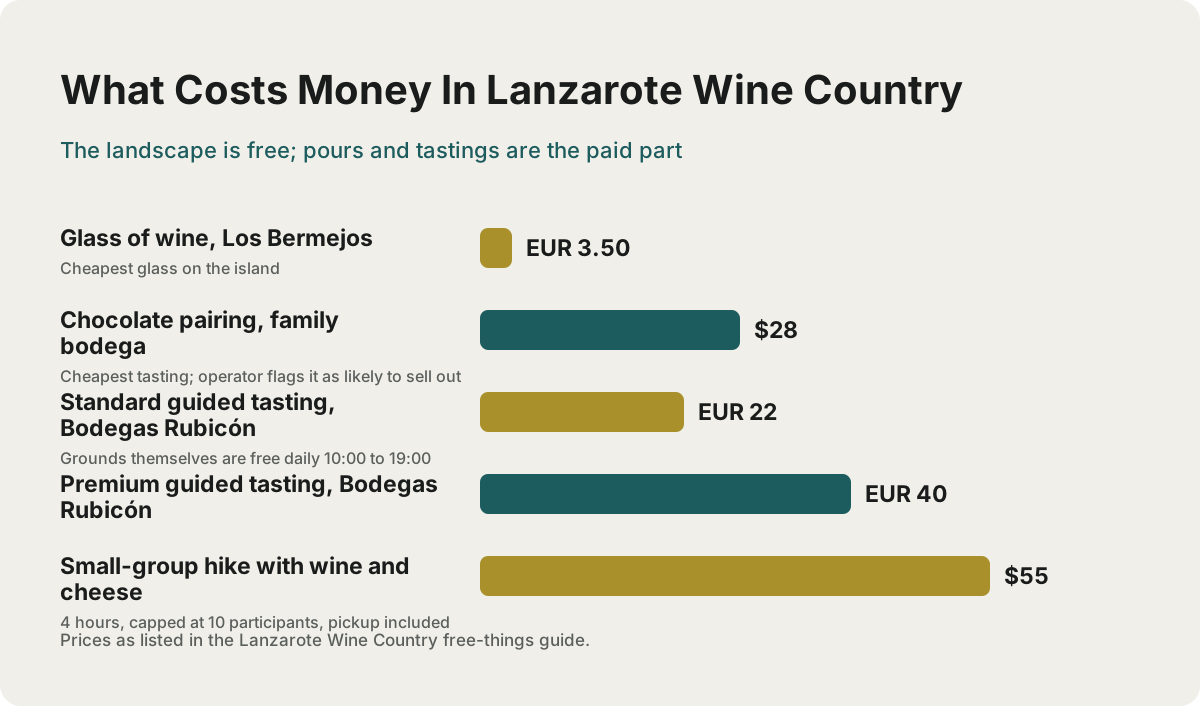
The cheapest structured tasting with a guide, rather than a self-drive glass, is the $28 chocolate pairing tour: an hour and a half at a family bodega, with an artisan chocolate pairing served alongside the wines, rated 4.8 across 482 reviews, and flagged by the operator as likely to sell out. It is the natural first paid step up from a free day, and it is the tour we would point a budget traveller at first.
For a deeper comparison of the wineries themselves, including which ones suit which kind of visitor, see our Lanzarote wineries guide, and for the tasting landscape in detail, the Lanzarote wine tasting guide covers formats, prices and etiquette.
Timanfaya Viewpoints: Seeing The Volcanoes Without The EUR 30 Ticket
You can see Timanfaya's volcano cones for free from public roads on the edge of the park, including stretches of the LZ-30 and the roads around Yaiza and Uga, but the park itself cannot be entered freely by car or on foot. The Montañas del Fuego experience costs EUR 30, children under 7 free, and it now requires a pre-booked online time slot, with no ticket sales at the gate at all.
That last fact changed the arithmetic of a cheap day. CACT, the Cabildo body that runs the centres, states it plainly: there are no box-office sales at Montañas del Fuego, tickets must be bought online in advance, you choose a date and a time slot, and you arrive 15 minutes before it. If a slot is not offered, that quota is full. The same mandatory timed booking applies to Cueva de los Verdes. Timanfaya was Spain's fourth most visited national park in 2024, with just under 1.5 million visits, so slots in high season are a real constraint, not a formality.
The free alternative is honest and genuinely good: the exterior viewpoints. The park's cones rise straight off the La Geria plain, and from several public points around Uga and along the valley you get the full silhouette, black and red, against the sky, with the vine pits in the foreground. Rubicón's free terrace, covered above, looks directly at the park and the village of Uga. What you cannot get for free is the interior: the Ruta de los Volcanes coach route, the geothermal demonstrations at Islote del Hilario, the park's own guided walking routes. Those are inside the boundary, and the boundary is enforced.
| CACT centre | Adult price | Free option |
|---|---|---|
| Montañas del Fuego (Timanfaya) | EUR 30.00 | Viewpoints outside the park only |
| Cueva de los Verdes | EUR 17.00 | None |
| Jameos del Agua | from EUR 17.00 | None |
| Jardín de Cactus | EUR 9.00 | None |
| Mirador del Río | EUR 9.00 | None |
| Castillo de San José (MIAC) | EUR 5.40 | None |
| Casa Museo del Campesino | Free | The whole site |
One thing to check if you are considering a paid wine-and-volcano day: no operator on our roster sells a Timanfaya day with a real tasting attached, so a listing that says "includes Timanfaya" is either paying the Montañas del Fuego entry or driving you past the park. Read what the listing actually says before assuming the entry is in the price. Our Lanzarote wine and volcano tours guide breaks this down tour by tour.
The Free CACT Sites: Casa Museo Del Campesino And The Manrique Trail
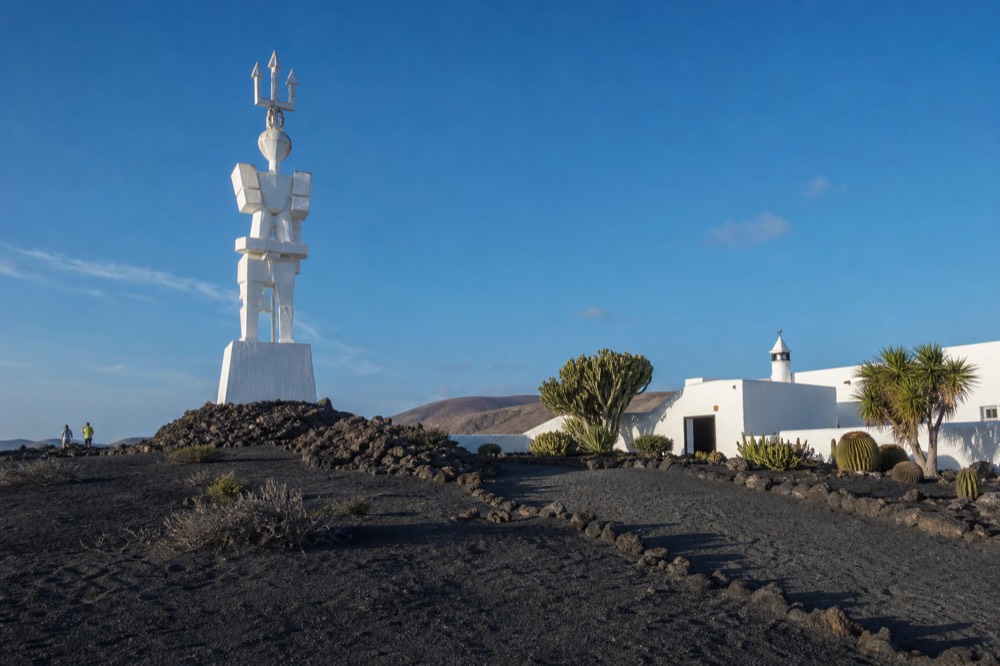
The Casa Museo del Campesino, on the LZ-30 at the northeastern gateway to La Geria, is completely free, open daily 10:00 to 18:00. It is a museum of Lanzarote farming built around César Manrique's Monument to Fecundidad, his tribute to the island's agricultural knowledge, and it is the one CACT site that costs nothing. It is also the natural first or last stop on a free drive of the valley.
The site does something the paid centres do not: it explains the farming you have been looking at. The hoyos, the zocos, the ash cultivation, the crops grown in jable sand, all of it is the subject here, and after a morning of free viewing along the LZ-30 the museum gives the landscape a vocabulary. The giant white sculpture outside, Manrique's monument to the farmer, is one of the island's most photographed works and costs nothing to stand beneath.
Beyond it, the free Manrique trail thins out. Jameos del Agua, the first centre he created, costs from EUR 17. Mirador del Río, the building he conceived on the Famara cliff, costs EUR 9. The Jardín de Cactus, EUR 9. All are worth their prices, but none is free, and a day built strictly on zero euros should treat them as a separate budget. The Museo Atlántico, the submerged sculpture museum off Playa Blanca, has been in place since its inauguration in January 2017, and viewing it at all requires diving, so it belongs nowhere near a free list.
The Sunday market in Teguise deserves its place here too. Wandering it costs nothing, the setting is the old island capital, and Teguise remains listed in the Los Pueblos Más Bonitos de España network, though that listing is attributed to local press rather than confirmed on the network's own site. Buying anything is, obviously, not free, and the market is a morning event, so it pairs better with an afternoon in La Geria than the other way round.
Free And Pay-What-You-Want Walking Tours: What To Verify Before You Rely On One
A quick correction for anyone hunting a free wine day out: no pay-what-you-want tours run in La Geria itself, and every wine experience on this island charges a from-price, starting at $28 for the vineyard visit with wine and chocolate at Guaticea. The genuinely free option nearby is landscape, not wine. Timanfaya's Montañas del Fuego lets under-7s in at no charge, though the park cannot be explored freely by car or on foot, so everyone else pays for the official bus route. If your budget is tight, the short bodega tastings are the affordable middle ground.
- Free Tour Discover Arrecife (4.58 across 258 reviews, meets at the Agustin de la Hoz House of Culture). Guided in Spanish only. See this free tour on GuruWalk
- Free Tour The Villa of Teguise (4.76 across 130 reviews, meets at Calle Santo Domingo 8). Guided in Spanish only. See this free tour on GuruWalk
Be clear about what these walks are: town walks, in Arrecife and in Teguise. Neither sets foot in La Geria, so neither replaces a bodega visit among the vines. If free walking in the wine country is what you are after, you can do that yourself. The lanes around Uga and Masdache put you among the walled vine pits, and the verges of the LZ-30 give you a slow drive or cycle past the bodegas with no ticket and no guide. Pair a morning of that with a booked tasting from $28 and you have the substance of a wine day for very little.
Be honest with yourself about what pay-what-you-want means. These walks are not free, they are unpriced. A guide spends a couple of hours showing you round Arrecife or Teguise, pointing out things you would walk straight past on your own, and takes home only what you hand over at the end. Budgeting nothing for that is a mistake. Decide what the walk is worth before you set off, carry cash, and treat the tip as the real price of the tour.
If a guided walk with wine at the end is what you actually want, the paid version exists and is well reviewed: the El Grifo bodega experience pairs a cheese tasting with the winery's own pours, $58, 2 hours, limited to 10 participants, rated 4.9 across 365 reviews. It is a step up in price from the chocolate pairing, but it is the one that turns a free landscape day into a winery day at the island's most decorated bodega.
El Grifo, founded in 1775 by the inscription on its own wine press, closed its 250th anniversary year in October 2025 with an official visit from Spain's agriculture minister, and it took two gold medals at Mundus Vini 2026. The winery calls itself one of the ten oldest in Spain, which is the claim its own site makes, and it holds a Canary Islands Tourism Award for Tourist Excellence 2025. None of that is free to experience, but all of it is visible from the free road outside.
Where The Free Day Ends: Why Every Bodega Charges For The Pour
The free day ends at the tasting room door, and for a reason you can respect: this is one of the least productive wine regions in Europe. La Geria yields around 1,000 kg of grapes per hectare against a legal ceiling of 7,000, and the 2025 harvest brought in 843,000 kg island-wide. Scarcity is why nobody pours for free.
Growers were paid about four euros a kilo for grapes in the 2026 campaign, and the 2026 harvest is forecast by the Consejo Regulador to close above three million kilos, roughly triple 2025, after two short years. Even in a good year, though, the arithmetic of the hoyos does not change: hand-dug pits, hand-tended vines, yields a seventh of what the appellation permits. A free tasting would be a gift the valley's economics cannot support, and the EUR 3.50 glass at Los Bermejos is, in that light, not a tourist trap but close to a break-even.
| Free element | What it is | What it costs to upgrade |
|---|---|---|
| LZ-30 miradors | Roadside views over the hoyos | Guided hike with tasting, $55 |
| Uga and Masdache lanes | Self-guided walks among the zocos | Small-group guided hike, capped at 10 |
| Rubicón grounds | Free facility access, terrace view | EUR 22 or EUR 40 guided tasting |
| Timanfaya exterior viewpoints | Volcano cones from public roads | EUR 30 Montañas del Fuego, timed entry |
| Casa Museo del Campesino | Free museum of island farming | No upgrade needed |
| Teguise Sunday market | Free to wander the old capital | Whatever you buy |
One planning fact that makes the paid upgrade easier to justify: every resort on the island is inside half an hour of La Geria. Puerto del Carmen is about 14 km away by road, Playa Blanca about 24 km, Costa Teguise about 28 km. A tasting tour is a half-day, not an expedition, and Spain's drink-drive limit of 0.25 mg/l in breath, lower than the UK's 0.35, is the honest reason a driven tour beats self-driving between bodegas. A tasting flight will not leave most people comfortably under that limit. On Lanzarote Wine Tours we keep that fact on every driving page because it is the single best argument for letting someone else take the wheel.
For the budget traveller who wants the landscape free and one paid pour at the end, the sunset chocolate tasting is the cheapest way to combine the valley's best light with a tasting: $30, 1.5 hours, two artisan chocolate bonbons, rated 4.7 across 190 reviews, and flagged as likely to sell out.
And if the day has earned a bigger spend, the four-wineries tour with brunch and tapas at an 1890 bar is the full version: $176, 6 hours, pickup included, rated 4.9 across 51 reviews. It is the opposite end of the price range from the free day, which is exactly why it belongs at the end of this list rather than the start.
The short answers: La Geria's landscape is free, Timanfaya's cones are free to view but its interior is not, Rubicón is the only winery with free facility access, and the Casa Museo del Campesino is the one CACT site that costs nothing. Every pour, everywhere, is paid. Here are the specifics.
Common Questions About Free Things To Do In Lanzarote Wine Country
Is La Geria Free To Visit?
Yes. La Geria is a Protected Landscape, not a ticketed attraction, and the vine pits, zocos and miradors along the public LZ-30 road cost nothing to view. The wineries inside it charge for tastings, and Rubicón is the only one that publishes free access to its facilities, daily 10:00 to 19:00.
Can You See Timanfaya For Free?
You can see the volcano cones from public roads and viewpoints around Uga and the La Geria plain, including Rubicón's free terrace, but you cannot enter the park freely by car or on foot. The Montañas del Fuego experience costs EUR 30 and now requires a pre-booked online time slot, with no ticket sales at the gate.
Are Any Lanzarote Wineries Free To Enter?
Bodegas Rubicón publishes free access to its facilities daily from 10:00 to 19:00, including the grounds and the terrace view. Its guided tastings cost EUR 22 and EUR 40. Los Bermejos needs no booking for a EUR 3.50 glass tasting during its Monday to Friday 08:00 to 15:00 hours, but that is not free.
What Is The Cheapest Wine Tasting In Lanzarote?
By the glass, Los Bermejos at EUR 3.50 with a cheese cap. As a structured tour, the chocolate pairing at a family bodega is $28 for 1.5 hours and is the lowest-priced product on our roster. Both are far cheaper than the multi-winery tours with transport, which start at $80.
Is The Casa Museo Del Campesino Free?
Yes, it is the one CACT centre that costs nothing, open daily 10:00 to 18:00, and it sits on the LZ-30 at the gateway to La Geria. It explains the island's farming systems, including the hoyo cultivation you see across the valley, and Manrique's Monument to Fecundidad stands outside it.
Are There Free Walking Tours In Lanzarote Wine Country?
No specific free or pay-what-you-want wine-country walking tour is currently verifiable. Pay-what-you-want city walks exist in the Canaries and may run in Arrecife or Teguise, but confirm the schedule live on the operator's listing before relying on one. The free alternative is walking the Uga and Masdache lanes yourself, or the paid small-group hike at $55 with a tasting included.