What Is The Nicest Canary Island To Visit?
An island-by-island answer to which Canary Island is nicest, with Lanzarote's case made on volcanic landscape and wine rather than beaches.
 By Sergio Betancort, Lanzarote Wine Tour Specialist and Volcanic Vineyard Guide
What Is The Nicest Canary Island To Visit?
The honest answer is that no single Canary Island is "the nicest": Tenerife suits mountain and nightlife lovers, Fuerteventura suits beach purists, Gran Canaria suits travellers who want everything in one week, and Lanzarote suits people who care about landscape, design and wine more than long beaches. If your idea of a beautiful island is a black volcanic valley full of hand-dug vine pits, Lanzarote is the pick of the archipelago, and this site exists because of that valley.
The question gets asked constantly, and the internet usually answers it with a list of superlatives: biggest, warmest, best beaches. That framing hides the real point. The Canaries are seven substantially different islands that happen to share a flag. Tenerife carries a snow-capped volcano taller than anything else in Spain; Fuerteventura is essentially a chain of dunes and beaches 100 kilometres long; La Palma is a green, vertical, hiking-mad place; Lanzarote is a flat, arid, ash-covered slab where farmers grow wine in pits.
So the useful version of the question is not "which is nicest" but "which is nicest for you". The comparison below works through the four biggest islands honestly, including the areas where Lanzarote loses, and then makes the case for the island this site covers: not on beaches, where Lanzarote is genuinely weaker, but on landscape and wine, where nothing else in the archipelago comes close.
If you already know you want Lanzarote's wine country, these are the three experiences that best show what the island does that the others cannot:
The trio above spans the range: a small-group hike through the volcanoes and vineyards, a natural-wine tasting with a Canarian food plate, and a full six-hour, four-winery day with brunch and tapas. All three include free cancellation, which every tour on this island's roster offers, so booking early costs you nothing if your plans shift.
Which Canary Island Suits Which Kind Of Traveller?
Pick Tenerife for mountains, nightlife and the biggest flight choice; pick Fuerteventura for beaches and water sports; pick Gran Canaria for variety, from dunes to pine forests in one drive; pick Lanzarote for volcanic landscape, low-rise design and wine culture; pick La Palma for hiking and greenery; pick La Gomera or El Hierro for quiet. The "nicest" island is the one whose strength matches what you actually do on holiday.
The table below is a starting grid, not a verdict. Every island has more than one face, and the smaller islands, La Gomera, El Hierro and La Palma, reward travellers who already know the archipelago.
| Island | Best for | Weakest point | Who should pick it |
|---|---|---|---|
| Tenerife | Teide, walking, big resorts, nightlife | Crowds in the south, the busiest island | First-time visitors who want everything, including a cable car up a volcano |
| Fuerteventura | Beaches, kitesurfing, driving dune roads | Arid and flat, limited culture or wine | Beach-first travellers and surfers |
| Gran Canaria | Variety: dunes, mountains, old towns in one week | No single standout landscape | Travellers who want a bit of everything without island-hopping |
| Lanzarote | Volcanic landscape, La Geria's vineyards, Manrique's design | Few long natural beaches | Landscape, photography and wine travellers |
| La Palma | Hiking, greenery, star-gazing | Fewer flights, fewer beaches | Walkers on a second or third Canarian trip |
| La Gomera / El Hierro | Quiet, ravines, slow travel | Small, slow to reach, few amenities | Repeat visitors chasing solitude |
One practical point that rarely makes the comparison articles: scale. Lanzarote is small enough that every resort sits within half an hour of the wine country, roughly 14 to 28 kilometres by road from the main bases to La Geria. On Tenerife or Gran Canaria, the wine regions sit further from the main resorts, so a day trip means a long drive. That compactness is a real quality-of-life difference on a one-week holiday, and it is part of why wine tourism works so well here.
Why Does Lanzarote's Case Rest On Landscape Rather Than Beaches?
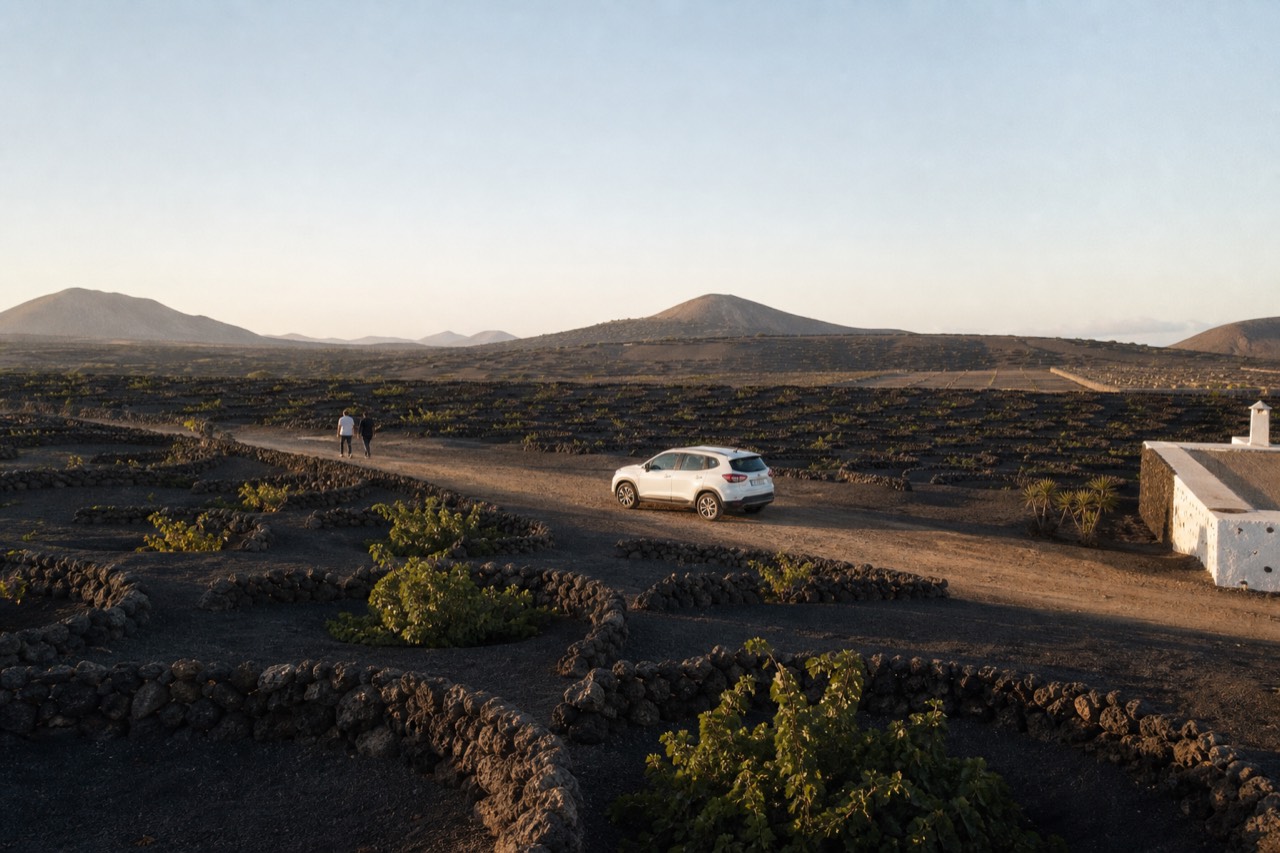
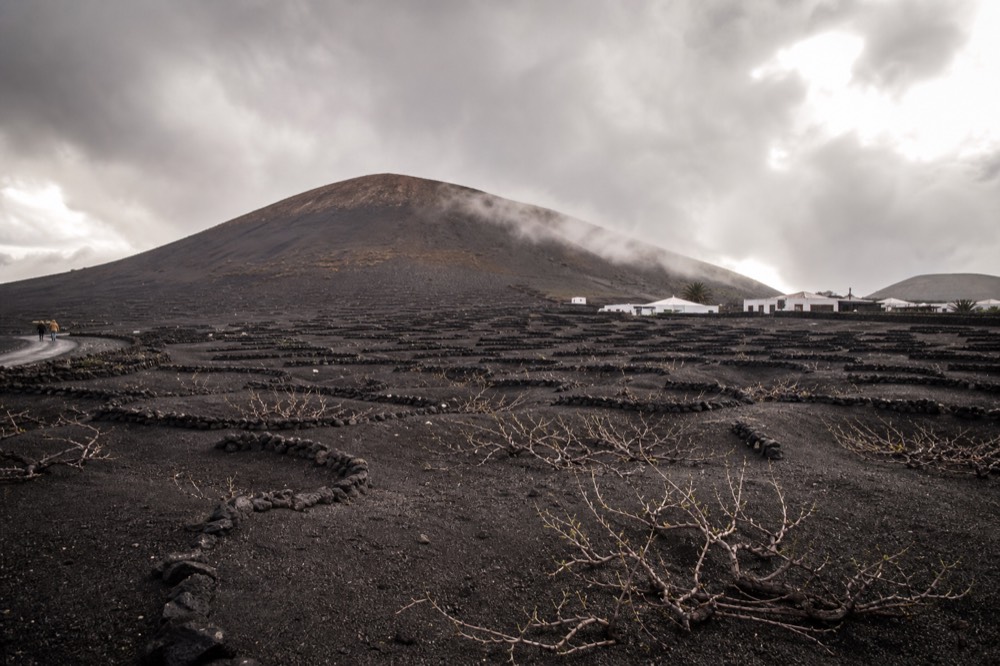
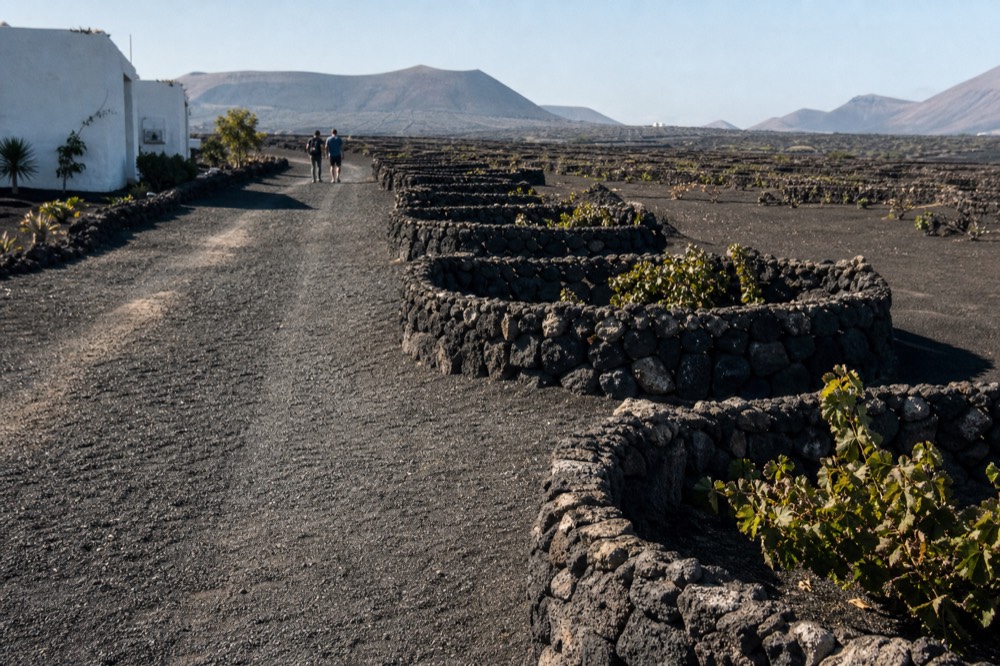
Because on beaches Lanzarote loses to Fuerteventura outright, and on landscape it wins against everything in the archipelago: six years of eruptions between 1730 and 1736 buried its farmland in ash, and farmers responded by digging vine pits through it, creating La Geria, a 5,255-hectare protected landscape of hand-dug hollows and half-moon stone walls that exists nowhere else in Europe.
That is not marketing copy. The eruptions are documented in the appellation's own product specification, the protected-landscape status is Canarian law, and the growing system itself, vines planted in pits about three metres across and two to two and a half metres deep, dug down to the soil buried by the ash, comes straight from the same legal text. In the deepest-ash zone there are roughly 36 of those pits per hectare, against thousands of vines per hectare in a conventional vineyard. The half-moon stone walls all face the same way because the trade winds do: they shield each vine from the north-northeast.
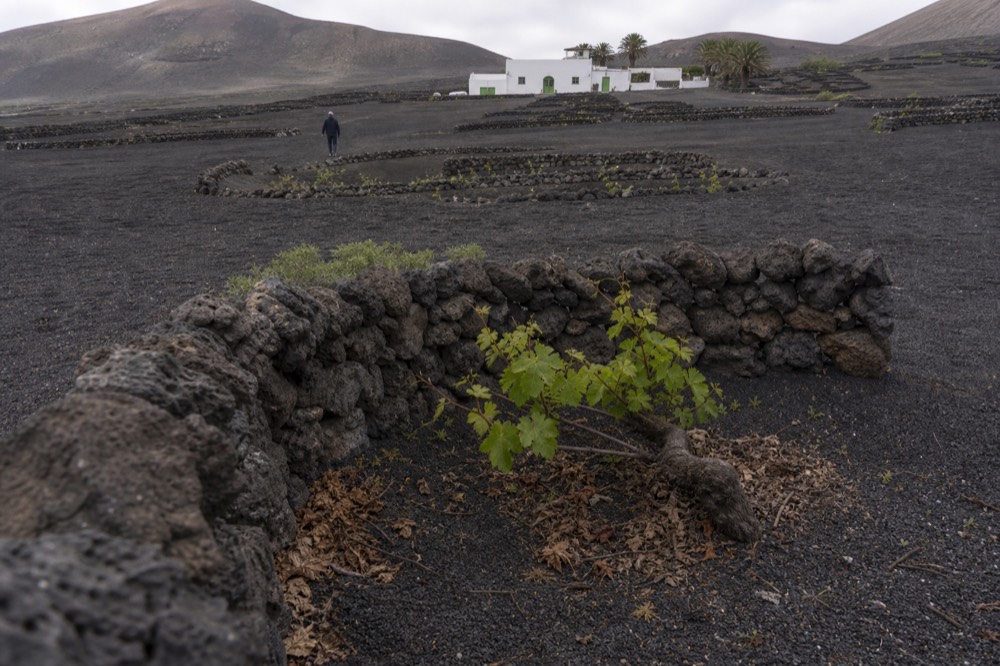
In 2025 the island's volcanic dry-farming system was added to the FAO's Globally Important Agricultural Heritage Systems list, registered as "Agricultural Systems in Jable and Volcanic Sands in Lanzarote Island, Spain" on the FAO's own GIAHS page. That is international recognition of the landscape as agriculture, not just scenery, and almost no "nicest Canary Island" article you will read carries it, because it is new and it is specific.
Then there is Timanfaya. The national park recorded 1,492,435 visits in 2024, making it Spain's fourth most visited national park, and you cannot walk or drive into it freely: the park's operator runs a coach route through the lava fields, and entry now requires an online ticket with a chosen time slot, with no box-office sales at all. A landscape that strict, that protected and that popular is a genuine differentiator. Fuerteventura has nothing like it; Tenerife's Teide is magnificent but it is a mountain, not a six-year eruption scar you can ride through in 35 minutes.
The island's look is the other half of the case. The low white buildings and the absence of roadside clutter come out of the island's planning rules, which UNESCO credits to the Insular Land Plan adopted in 2001, with the influence of the Lanzarote-born artist César Manrique written into the visitor centres he designed. The result is an island that does not look like a resort strip, which is precisely what many "nicest island" voters are actually voting for. For more on the valley at the heart of it, see the La Geria wine region guide.
The best way to understand that landscape is to walk through it rather than drive past it, and the small-group hike below does exactly that, finishing with the wine the landscape produces:
Is Tenerife The Nicest Canary Island?
For many travellers, yes: Tenerife has the archipelago's tallest mountain, its widest flight and hotel choice, and at the Canaries' own official 2026 wine competition its wines took the top honours, so if you want mountains, nightlife and wine in one island, Tenerife is a strong answer. But it is also the busiest and most developed island, and its wine country, while real, is scattered rather than concentrated into one visible landscape.
The wine point deserves honesty. At the Concurso Oficial de Vinos de Canarias 2026, the Best Wine of Canarias award went, ex aequo, to two Tenerife wines: Pico Cho Marcial Tinto from DOP Islas Canarias and Flor de Chasna Blanco Naturalmente Dulce from DOP Abona. Lanzarote's wines did not take the top title. A site that admits that and then explains what Lanzarote does differently is more credible than one that pretends otherwise, and what Lanzarote does differently is landscape and wine tourism rather than raw medal counts.
Tenerife also carries the archipelago's phylloxera outbreak. The Canary Islands were free of the louse until the first case was confirmed on Tenerife in late July 2025, and the 2026 survey campaign found four new positives, all confined to the demarcated zone on Tenerife. Lanzarote's vineyards were inspected 1,373 times in that campaign with nothing found. For a traveller this changes nothing; for a wine traveller it is a reminder that Lanzarote's vineyard landscape is intact and, so far, untouched.
The honest comparison of the two islands, beaches, crowds, cost and character, is worked through in Lanzarote or Tenerife: which is nicer?, and the short version is this: Tenerife wins on scale and choice, Lanzarote wins on coherence. One island looks like a continent, the other looks like a single idea carried through everywhere, from the vine pits to the white walls to the roundabouts.
What About Gran Canaria, Fuerteventura And The Smaller Islands?
Gran Canaria is the "continent in miniature", offering dunes, pine forests and old towns within one hour's drive, which makes it the safest all-round pick for mixed groups; Fuerteventura is the beach island, with sand and surf that outclass everything else in the archipelago; La Palma, La Gomera and El Hierro are quieter, greener and better for walkers who already know the Canaries. None of them has Lanzarote's wine landscape.
Gran Canaria's strength is genuinely hard to argue with if your group cannot agree on a holiday. It is also the only Canary island in the Rutas del Vino de España network, the Spanish wine-route association, so it has an organised wine-tourism offer. What it does not have is a single landscape that stops conversation. Its wine country is pleasant and spread out; Lanzarote's is otherworldly and concentrated along one road, the LZ-30, which runs the length of La Geria from the Monumento al Campesino junction down to Uga.
Fuerteventura is the mirror image. It beats every other island on beaches by a distance, and it beats Lanzarote on beaches the same way, but its interior is arid, flat and, outside the dune parks, unremarkable. Travellers who rank beaches first should simply go there. Travellers who would trade a perfect beach for a morning walking through vine craters should not.
The smaller islands are a different conversation. La Palma is the walking island, steep, green and quiet; La Gomera and El Hierro are for slow travellers. All three are lovely and none is the answer for a first visit, because they trade convenience for character. If you have already done the big islands, La Palma is the nicest of the three by most reckonings.
A scale note that helps the choice: Lanzarote recorded 3,455,200 tourist arrivals in 2025, a record, against roughly 3.4 million in 2024 and 3.06 million in 2019. It is busy, but its tourism is spread thin across a small island, and its hotels took 801 million euros in 2025 on 86.8 per cent occupancy with an average rate of 142.40 euros a night, so rooms are not cheap and quiet seasons are short. The quieter islands are quieter partly because they are harder to reach.
Does Wine Tip The Balance Toward Lanzarote?
If wine matters to you at all, yes, and decisively: Lanzarote is the only Canary island where wine is the landscape itself, with an appellation covering the whole island, 41 registered bodegas, and a signature grape, Malvasía Volcánica, that defines its wines, while roughly 98 per cent of the DO's wine is drunk inside Spain, so tasting it here is often the only way to taste it.
Those numbers come from the Spanish agriculture ministry's DOP report and the appellation's own specification, and the last one is the fact that changes holidays. Lanzarote's wine barely leaves the country. About 84 per cent of what the DO sells is white, dominated by Malvasía Volcánica, and the export share is around two per cent. You cannot reliably buy it at home, and the 2025 vintage, officially qualified "very good" after a blind tasting of 23 wines, produced only 1,502,656 bottles from 843,000 kilos of grapes. The 2026 harvest is forecast to close above three million kilos, roughly triple, so supply is recovering, but scarcity remains the norm.
The quality question is answered elsewhere on this site in detail, including the strongest single piece of evidence: a Silver medal, 90 to 94 points, for Vega de Yuco's Princesa Gara 2022, a Malvasía Volcánica aged on lees, at the Decanter World Wine Awards 2026. For the full argument see is Lanzarote wine any good?.
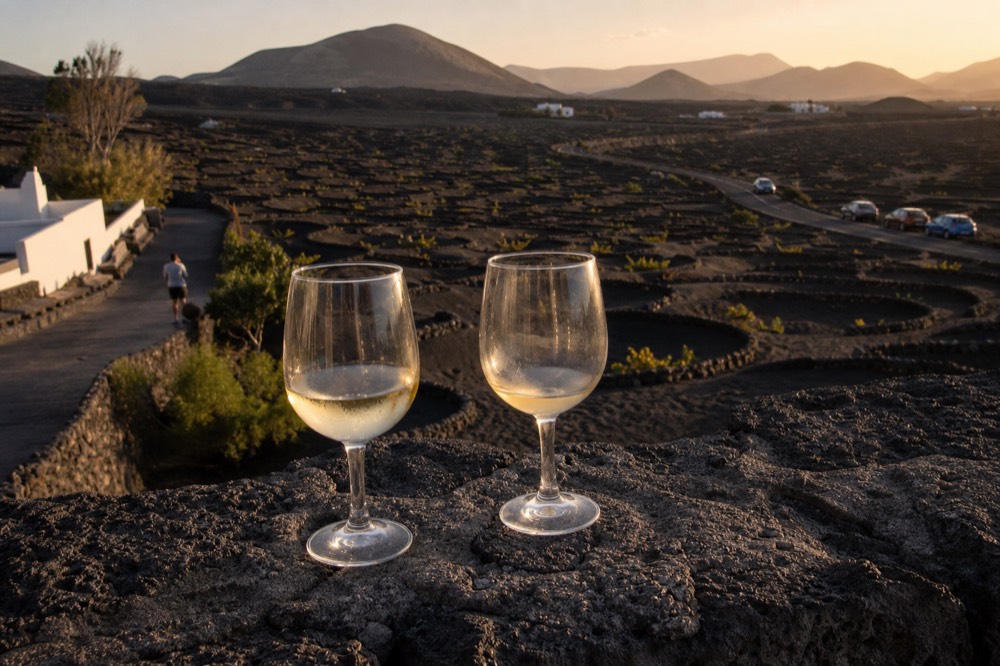
There is also a practical, safety reason to make wine a booked activity rather than a self-drive improvisation. Spain's general breath-alcohol limit is 0.25 mg/l, lower than the UK's 0.35, and a tasting flight in La Geria will not leave most people comfortably under it. A tour with pickup and drop-off solves that entirely, and it is the honest, sourced reason guided wine tours exist here. The four-winery day below is the fullest version, with brunch, tapas at an 1890 bar, and transport in the price:
For travellers who want the wine without the walking, the natural-wine tasting with a Canarian pairing plate, from $94, runs in small groups of 10 or fewer and covers the same story in 90 minutes. Whichever format you choose, book the winery experiences before you fly: several of the island's best small tastings are flagged as likely to sell out, and Timanfaya's new timed-entry rule means any volcano-and-wine day you plan yourself needs a pre-booked slot as well.
So, What Is The Nicest Canary Island To Visit?
For a first visit with no special interests: Gran Canaria, because it delivers the most variety with the least risk. For beaches: Fuerteventura. For mountains, nightlife and the biggest choice of everything: Tenerife. For landscape, design and wine: Lanzarote, and not by a small margin, because its volcanic vineyard country is a UNESCO-biosphere, FAO-recognised agricultural landscape that no other island in the archipelago, or in Europe, can put in front of you.
The verdict this site would defend is simple. If you measure an island by its beaches, Lanzarote is not the nicest Canary Island and this article will not pretend otherwise. If you measure it by how unlike everywhere else it is, by whether one week there changes how you think about farming, landscape and wine, Lanzarote wins the archipelago and competes with anywhere in Spain.
That is also why Lanzarote Wine Tours exists as a site rather than a general Canary travel guide: the island's wine country is specific enough, and unusual enough, to deserve its own coverage, from the wineries worth visiting to the walks between the volcanoes. Whatever island you pick, pick it for reasons you can name, and if the reasons you can name are ash, vines and stone walls, you already have your answer.
If that answer is Lanzarote, these three experiences cover the range of what the island does best:
The short version of everything above: Gran Canaria is the safest all-round pick, Fuerteventura is the beach answer, Tenerife is the scale-and-choice answer, and Lanzarote is the landscape-and-wine answer, with a vineyard country recognised by the FAO in 2025 that no other island in the archipelago can match. The questions below cover the comparisons people actually ask.
Common Questions About The Nicest Canary Island
What Is The Nicest Canary Island To Visit?
There is no single answer: Tenerife suits mountain and nightlife lovers, Fuerteventura suits beach purists, Gran Canaria suits travellers who want variety in one week, and Lanzarote suits anyone who values volcanic landscape, low-rise design and wine culture over long beaches. If landscape and wine are your measures, Lanzarote is the pick of the archipelago.
Is Lanzarote Nicer Than Tenerife?
They are different rather than better or worse. Tenerife has the taller mountain, the bigger resorts and the wider choice of flights and nightlife; Lanzarote is smaller, more coherent in its design and far more distinctive in its landscape, with La Geria's volcanic vineyards found nowhere else. Travellers who want scale and options tend to prefer Tenerife; travellers who want a single striking idea of an island prefer Lanzarote.
Which Canary Island Has The Best Beaches?
Fuerteventura, clearly. Its dune coastline and consistent surf conditions outclass the other islands, including Lanzarote, whose beaches are good but shorter and more scattered. If a holiday means a long stretch of sand and warm water, Fuerteventura is the right answer.
Which Canary Island Is Best For Wine?
Lanzarote, on landscape and wine tourism. Its DO covers the whole island, it has 41 registered bodegas, its signature Malvasía Volcánica grape defines the wines, and roughly 98 per cent of its production is drunk inside Spain, so visiting is often the only way to taste it. Tenerife's wines took the top honours at the Canaries' official 2026 competition, so quality alone does not settle it, but the experience of wine country does.
Is Lanzarote Too Touristy?
It is busy: 3,455,200 tourist arrivals in 2025, a record. But the tourism is spread across a small island, the wine country itself stays quiet outside the main winery terraces, and the island's planning rules keep the built environment low and restrained. It feels far less built-up than the big resort strips of Tenerife or Gran Canaria.
Can You Visit Lanzarote's Wine Country Without A Car?
Yes. Several tours include pickup in the price, from three-and-a-half-hour winery circuits to the four-hour small-group hike through the volcanoes and vineyards, and every resort on the island sits within roughly half an hour of La Geria. Given that Spain's breath-alcohol limit of 0.25 mg/l is lower than the UK's, a tour with transport is the sensible way to do a tasting day.